
Sector · Early Learning (Kindergarten) · ages 3–6
Big feelings, small people, one calm place.
A three-year-old can't tell you they're overwhelmed. They show you. A SensPod gives them somewhere to go before the hard moment — and gives you back the rest of the room.
Start with the problem, not the size
In early learning, it's almost always one of these six.
Arrival
Separation at drop-off
The first twenty minutes decide the whole morning. A quiet place to land makes the goodbye survivable.
Transitions
Moving from one thing to the next
Circle to centres, indoor to outdoor, play to lunch — the changeovers are where the day falls apart.
Overload
Too loud, too bright, too many
Some children need less input, not more instruction. Fewer things to look at is the intervention.
Recovery
After a big feeling
Coming down takes longer than going up. Somewhere soft to finish crying, then rejoin.
1:1 time
Speech, assessment, a quiet chat
Early-years specialists need somewhere private that isn't the hallway floor.
Staff
Educators need it too
Nobody co-regulates a room of four-year-olds on empty. Five minutes changes the afternoon.
Built for small bodies
The pod is the same. The furniture is not.
A three-year-old should not be climbing onto adult furniture to calm down.
- Seating scaled to the age groupLow, stable, and easy to get into and out of without help.
- Worktop set to the child's heightOr specify the height-adjustable option and change it as they grow.
- Everything within reachSensory tools, scents and TouchPad all reachable from a seated child's position.
- Soft forms, no hard cornersRounded seating and edges throughout the interior.
- Full glass front — you always see themSupervision is never interrupted. That is a requirement, not a feature.
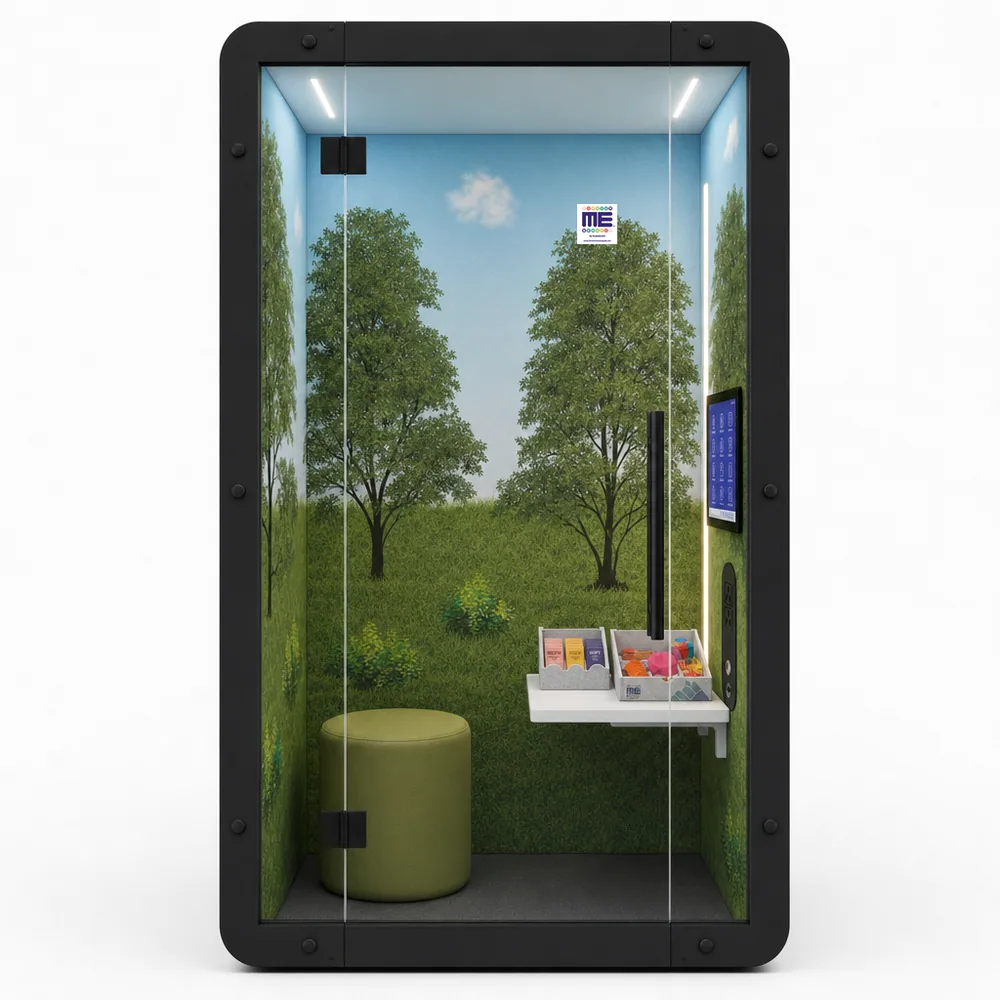
Where early-learning rooms usually land
Three starting points — the need decides which.
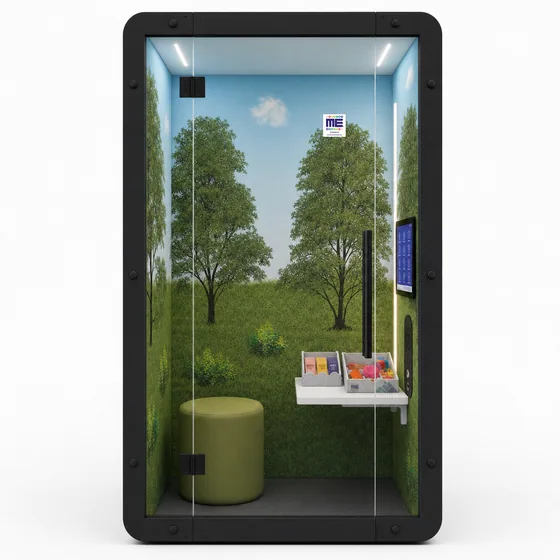
FM Selfi Plus
56 × 48 × 88″ · 1 person
Room to sit on the floor, which is where small children actually regulate. The floating shelf keeps the floor completely clear.
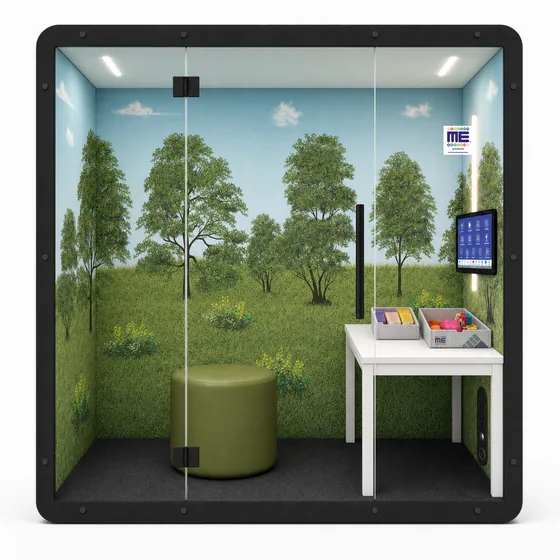
FM Me
88 × 37 × 88″ · 1 person
When the pod doubles as a quiet work spot — a real desk at child height for puzzles, drawing or focused table work.
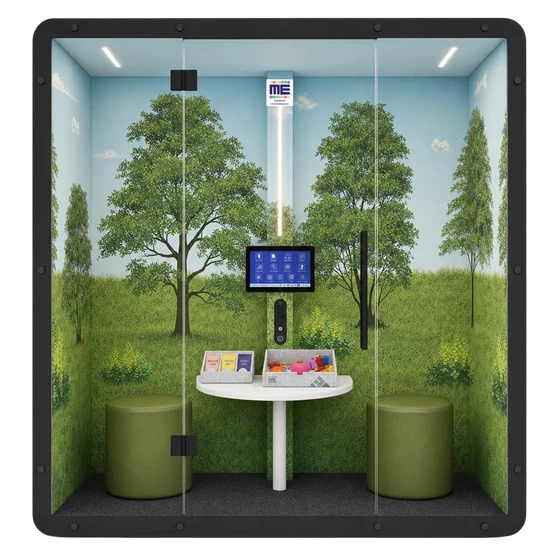
FM We
88 × 37 × 88″ · 2 people
The one most early-learning teams choose: a child and an educator, face to face. Co-regulation is the method at this age.
Every sector asks a different question
Same pod. Different need, different size, different furniture.
Kindergarten · ages 3–6
Early Learning (Kindergarten)
Separation, transitions, big feelings. Child-height furniture, full line of sight.
You are here.Grades 1–12
Grade 1–12
Regulation, focus and fewer removals from class — from Grade 1 through Grade 12.
All ages
Special Education Programs
Escalation, shutdown, sensory processing. Furniture matched to the individual student, not the average one.
Clinical
Private Clinics & Therapy Centres
A repeatable sensory setting for sessions. Soft seating for longer stays, adult or child scale.
Paediatric & acute
Hospitals & Pediatric Units
Procedure anxiety, long waits, and families with nowhere to go. Wipeable surfaces, full sight lines.
All ages
Libraries & Community Centres
Public space that works for everyone — including the people it currently doesn't.
Most early-learning teams don't know their size. They know their hardest hour.
Our discovery questionnaire maps what your children actually need, when the hard moments happen, how you supervise, and where a pod could realistically live — then turns that into a recommendation for size, quantity, placement and the furniture heights for your age group.
Ask for a recommendation
- Tell us your age group and setting
- Answer the questionnaire with us on a call
- Get a written recommendation
About 15 minutes. No cost, no obligation.