
Four elements, five worlds
Why five worlds, and not one calm interior
Every pod is the same shell — the same acoustic felt, the same TouchPad, the same light and air. What changes is the world printed inside it, and that world is doing real work rather than decorative work. Here is what each one is, and how it can help.
Earth
Nature
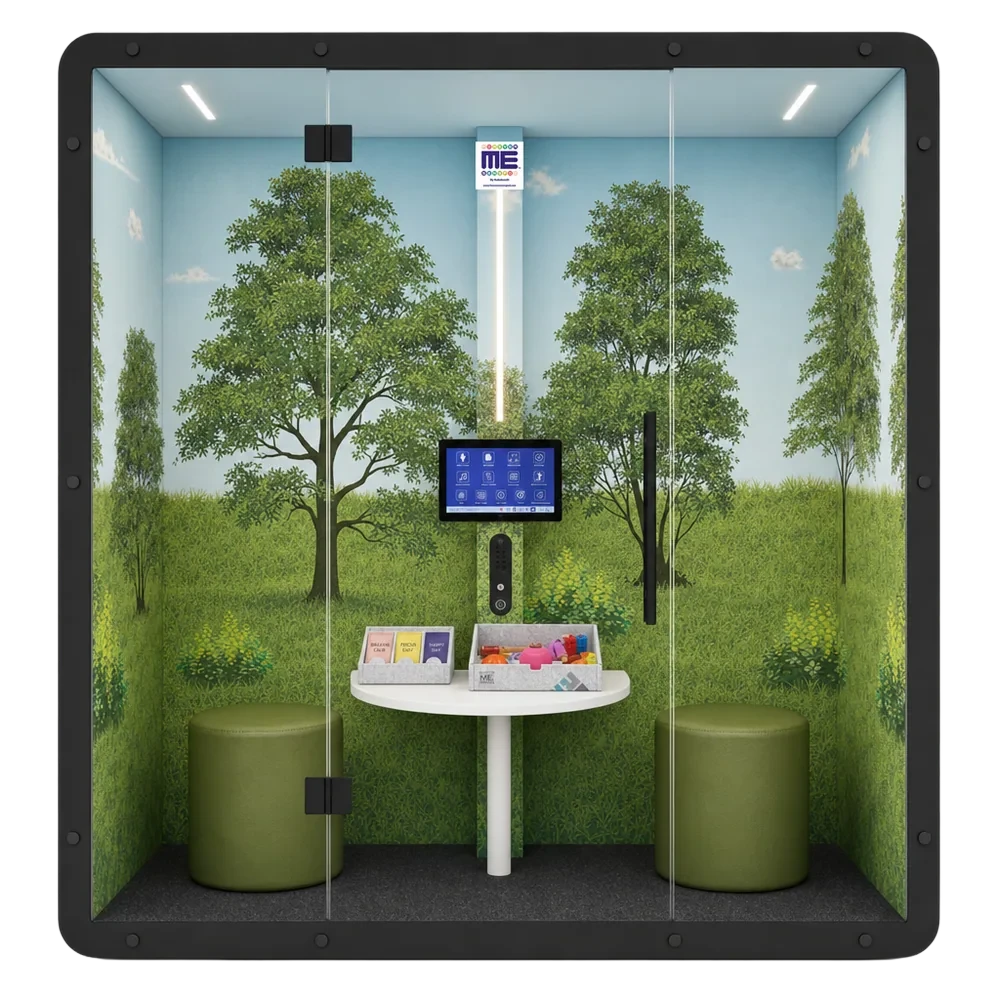
The meadow. The most familiar of the five, and the one that asks the least of you.
What is on the walls
Broadleaf trees in open grassland, wildflowers at the base, a high blue sky with light cloud. Green fills the lower two-thirds and the sky lifts the top of the box, so the ceiling reads as further away than it is.
What it does
Nature is the most directly evidenced of the five, because the comparison has been run in a school. Li and Sullivan gave students a green view, a bare view or no window at all, put them through a stressor and measured the recovery: the green view produced faster stress recovery and about 13 per cent more capacity for focused attention. Daylight on its own produced nothing. It was the green.
There is a quieter second mechanism. The branching of a tree sits in the mid-range fractal band that Taylor's group measured against skin conductance — the range associated with the largest falls in physiological stress, on the theory that human vision is tuned to read exactly that geometry at almost no cost.
What it gives you
Open ground and a high horizon — the feeling of standing outside in the middle of an ordinary good day. There is nothing in it to work out, and nowhere the eye is pushed to go.
The evidence
Li & Sullivan (2016), Landscape and Urban Planning. A green classroom view produced roughly +13% attentional capacity and faster stress recovery. Daylight alone had no effect.
Taylor et al. Mid-range fractal patterns (D ≈ 1.3–1.5) — the range of tree branching — produced the largest measured reductions in physiological stress.
Water
Aqua
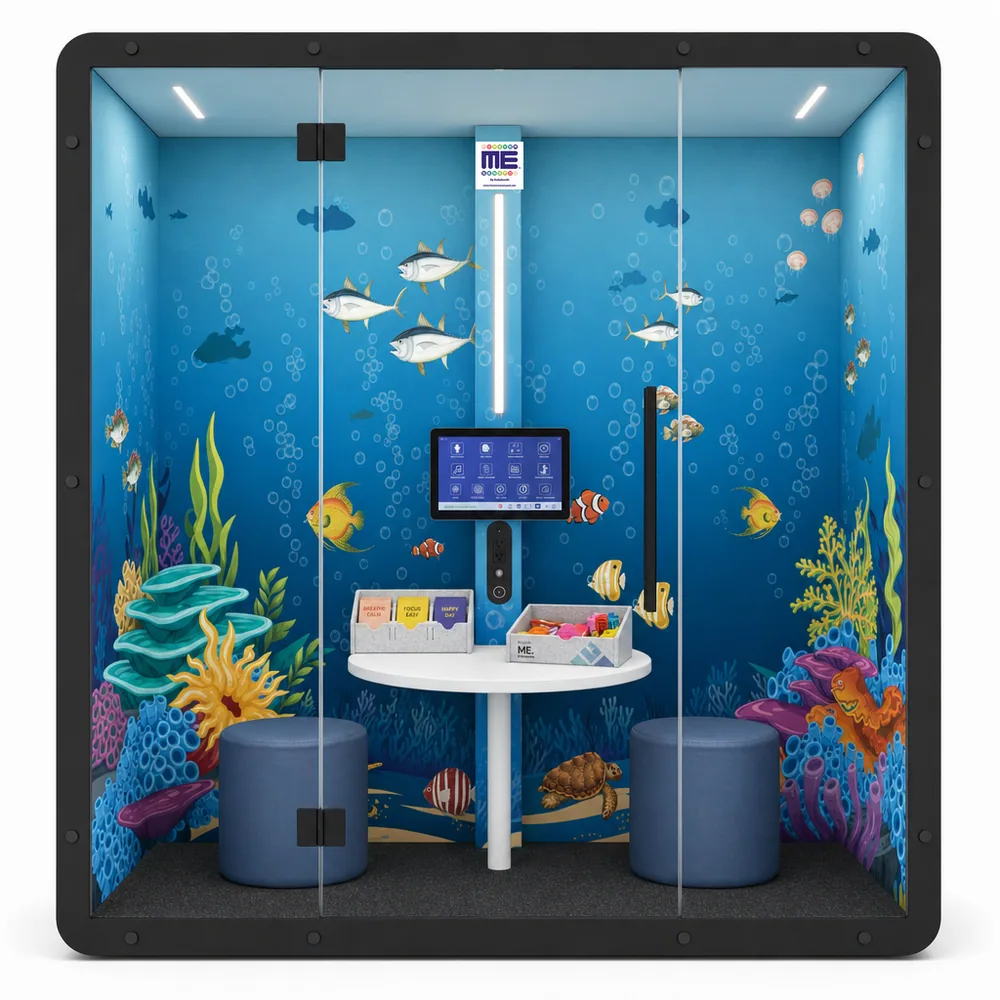
The reef. The most immersive of the five — the room outside disappears here soonest.
What is on the walls
A full-depth coral reef in deep and mid blues — angelfish, clownfish, rays, kelp and coral in pink, gold and teal — with the blue deepening toward the ceiling, so the box reads as water above you.
What it does
Cracknell and colleagues used the restocking of a large public aquarium as a natural experiment, measuring viewers at three stages: empty tank, partly stocked, fully stocked. As marine life was added, heart rate and blood pressure fell further, mood rose higher, and — the finding that matters most for a wall — people chose to watch for longer. More life in view, more effect.
The wider blue-space literature points the same way: being near water is associated with lower psychological distress and better wellbeing, in a number of studies at least as strongly as green. In practice a reef gives the eye something to travel across at a speed slower than a distressed body is moving — which is how a breath slows without anyone being asked to breathe.
What it gives you
Depth and slow movement. Blue on every side, and a scene that keeps offering the eye somewhere to go without ever hurrying it along. Aqua holds a gaze longer than any of the other four.
The evidence
Cracknell et al. (2016), Environment and Behavior. Adding marine life to a public aquarium produced progressively greater falls in heart rate and blood pressure, better mood, and longer voluntary viewing.
White et al. (2020), Environmental Research. Synthesis of the blue-space evidence: exposure associated with lower psychological distress and improved wellbeing.
Air
Harmony
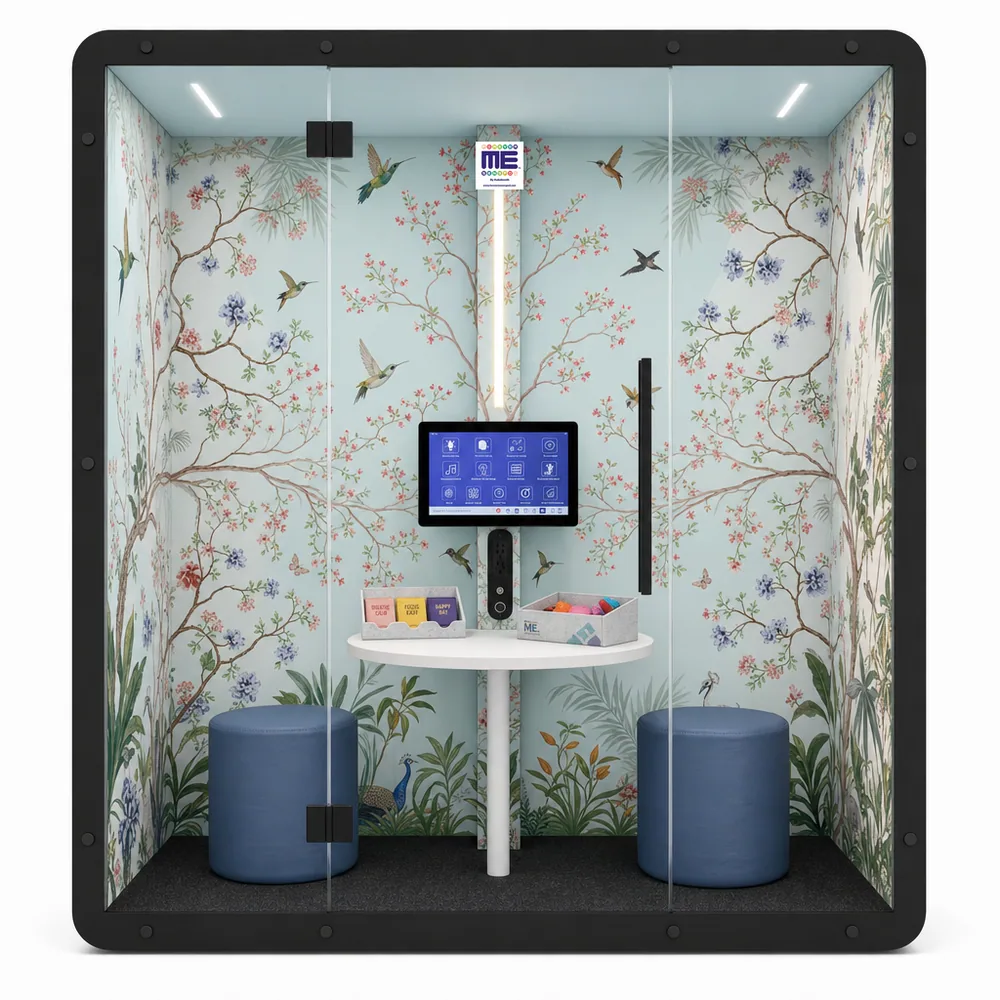
The blossom branch. The one that reads as a room rather than a scene.
What is on the walls
Chinoiserie botanicals: flowering branches climbing all three walls, hummingbirds and songbirds mid-flight, peonies and small blooms in dusty rose, cornflower and sage on a pale duck-egg sky, with a low band of ferns grounding the base.
What it does
Harmony is built for what Kaplan called soft fascination — looking that holds attention without demanding anything from it, and the specific mechanism attention-restoration theory says does the restoring. Fine detail rewards a long look, but nothing in the composition needs solving, counting or resolving. That is a narrow target, and this design hits it more precisely than the other four.
The composition is also prospect: you look outward through branches at open sky, the arrangement Appleton identified as the one people reliably read as both safe and pleasant. And the branching carries the same mid-range fractal geometry that does the quiet work in Nature.
What it gives you
Light, height and fine detail — a pale sky with something delicate to look at up close. It is the quietest of the five in colour and the richest in detail, and the one that reads as a room rather than a scene.
The evidence
Kaplan & Kaplan, attention restoration theory. Restoration depends on fascination that is effortless — a setting that draws the eye without recruiting directed attention.
Ulrich, supportive design and healthcare art. Representational nature imagery lowers anxiety in stressed viewers; ambiguous abstract work can raise it. Harmony is detailed, but never ambiguous.
Fire
Balance
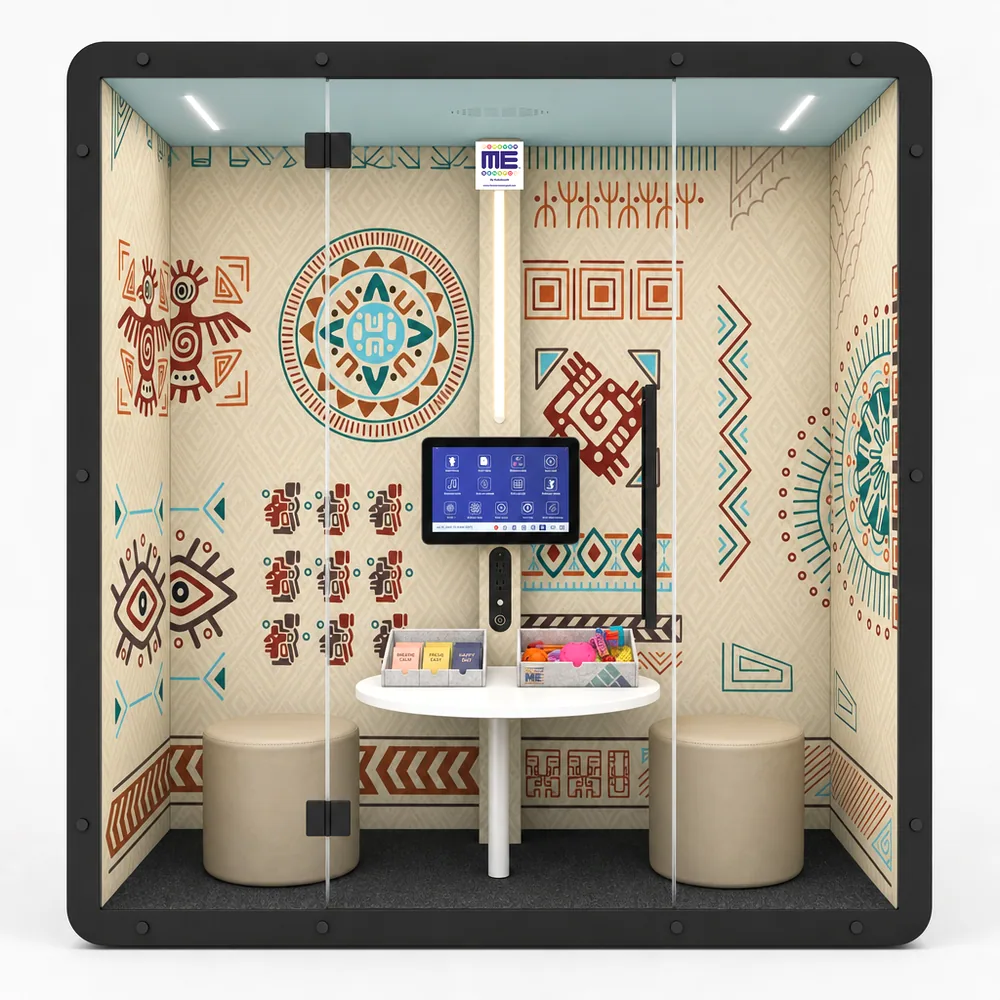
The hearth. The only one of the five that is not a landscape — and that is the point of it.
What is on the walls
Geometric earth ornament on a warm clay-cream ground with a woven texture: sunburst medallions, chevron bands, stepped fret patterns and stylised birds in terracotta, rust, ochre and teal. Warm, symmetrical, rhythmic, and made by hand rather than found in a field.
What it does
Two things, and the second matters more. First, pattern instead of scene. Repetition and symmetry are the visual equivalent of a steady beat: entirely predictable, so looking costs almost nothing. There is no narrative to follow and no depth to resolve.
Second, belonging. Cheryan and colleagues showed that the objects in a room tell people whether the room is meant for them — changing nothing but the decor of a computer-science lab measurably changed women's interest in the field. Where not everyone's landscape is a Canadian meadow, a world made of pattern rather than of place leaves nobody standing outside the picture.
What it gives you
Warmth, rhythm and symmetry. No landscape to step into and nothing to recognise — only pattern that repeats and holds. It is the steadiest of the five to look at, and the one that carries no picture of a place at all.
The evidence
Cheryan et al. (2009), JPSP — “ambient belonging”. Objects in an environment act as cues about who belongs there; replacing stereotype-laden decor raised women's interest in computer science to parity with men's.
Said plainly: the belonging evidence is what carries this design. Warm-colour psychology is a thin and contested literature, and we do not lean on it.
Aether · the fifth
Space
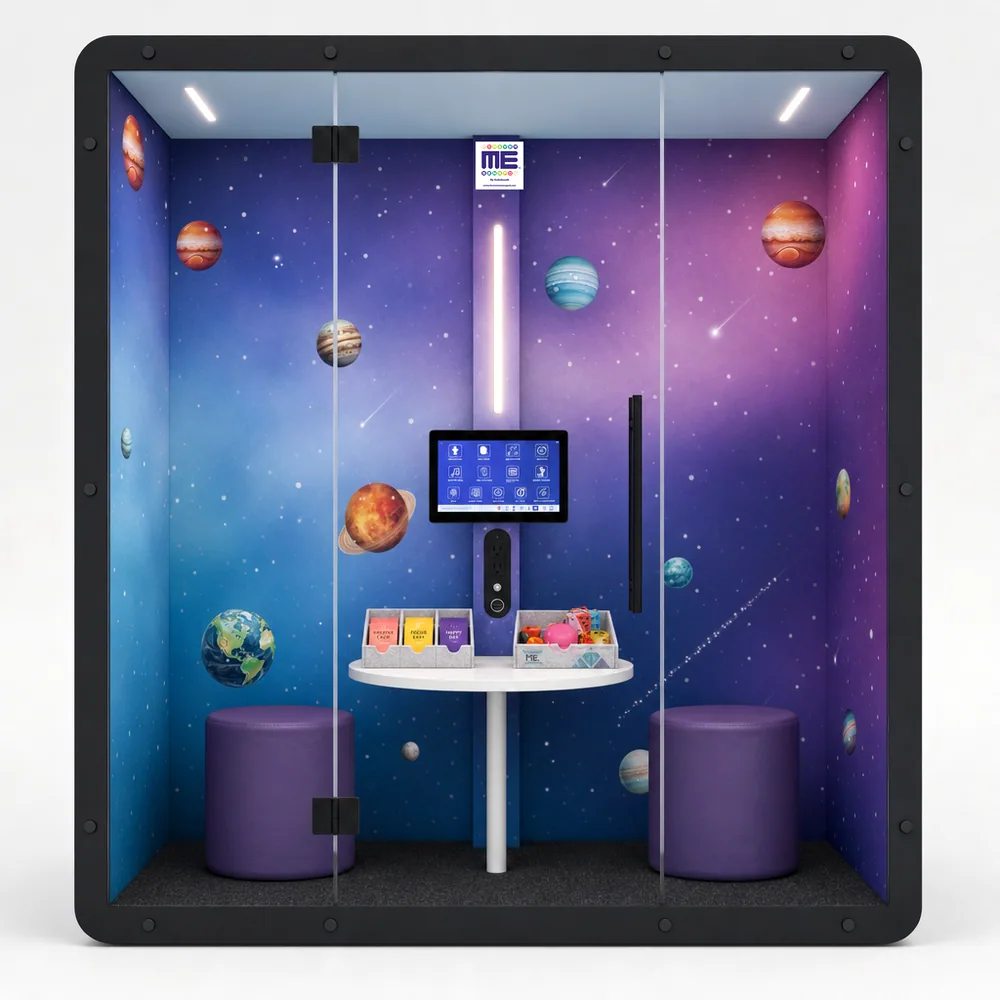
The galaxy. The fifth — not another element, but the one the other four are standing in.
What is on the walls
Deep violet and indigo, a dense starfield, ringed planets scattered across all three walls and Earth low on the left. By a wide margin the lowest-luminance interior we build.
What it does
Awe. Piff and colleagues ran five studies with more than two thousand participants and found that inductions of awe produced what they named the small self — a shrunken sense of one's own concerns — and with it more generosity, more ethical decision-making and less entitlement. The problem does not get smaller. The room around it gets bigger.
Light. Space is simply the dark option. Where bright is too much — light sensitivity, migraine, the shutdown end of sensory overload rather than the agitated end — a low-light interior is a genuinely different offer, and the other four are all bright.
What it gives you
Depth, dark and scale. The lowest light in the range and the largest sense of distance in it. The other four bring the outside in; this one opens the ceiling.
The evidence
Piff et al. (2015), JPSP. Five studies, N = 2,078. Awe reliably produced the small self and increased prosocial behaviour; standing in a grove of towering trees raised helping behaviour and lowered entitlement against control.
Stellar et al. (2015), Emotion. Positive emotions, awe most strongly among them, associated with lower levels of the inflammatory cytokine IL-6.
The five, side by side
Everything that actually differs between them, in one place.
| World | Light | What the eye does | Detail | What it gives you |
|---|---|---|---|---|
| Nature Earth | Bright, open | Rests on a far horizon | Moderate | Familiar ground and open sky |
| Aqua Water | Bright, saturated | Drifts, slowly and continuously | Rich | Depth and slow movement |
| Harmony Air | Lightest, palest | Settles on fine detail, close up | Highest | Delicacy and height |
| Balance Fire | Warm, even | Follows a repeating rhythm | Even — no focal point | Warmth and predictability |
| Space Aether | Darkest by far | Travels outward into distance | Sparse, on a dark ground | Scale and low light |
Two notes, offered rather than prescribed. Where a room is getting more than one pod, taking two worlds from opposite ends of this table gives people a real choice on the day rather than two versions of the same thing. And because the world is printed into the acoustic felt itself, none of these columns carries a price, a lead time or an acoustic difference.